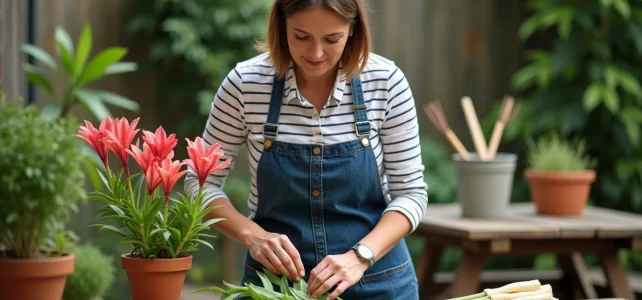
The vegetative propagation of the Inca lily has a particularity: some varieties categorically refuse to produce viable seeds. The success of cuttings then depends on the state of the tuberous roots and the choice of the right moment, often overlooked by beginner gardeners.
Methods, favorable periods, precise gestures, and common mistakes mark this journey. Practical solutions exist to circumvent frequent failures and ensure a quick and healthy recovery of new shoots.
Understanding the Inca lily: peculiarities and life cycle
Alstroemeria, also known as Inca lily or alstroemeria, catches the eye in flower beds with its vivid flowers and refined appearance. Native to South America, Chile, Brazil, Peru, this perennial from the alstroemeriaceae family blooms from May to September, offering a flowering that extends throughout the summer. Its foliage disappears during the cold season to return with the first beautiful days, a cycle dictated by the growth of its rhizomes buried in the ground.
There are many varieties: alstroemeria aurea, the ancestor of many hybrids, alstroemeria ligtu, alstroemeria psittacina with red hues, or Indian Summer with dark foliage. Their height ranges from forty centimeters to one meter, depending on the plant’s origin. All these lilies share a preference for fertile, airy, well-drained soil, devoid of too much lime, and appreciate dappled light or partial shade.
Their life cycle is marked by clear stages: after planting between March and May, or in the fall in a mild climate, the plant takes time to root. It often takes two to three years before the first major flowering. When mature, the clump becomes vigorous enough to consider division or Inca lily cuttings, a topic developed on the page “Multiplication of alstroemeria: techniques and tips – Conseil en Habitat.” The flowers, whether white, yellow, orange, pink, or variegated, are then proof of a well-managed cycle, a suitable environment, and a thoughtful variety selection.
What methods to multiply alstroemeria at home?
Multiplying the Inca lily requires choosing the technique best suited to the plant and its expectations. Three methods stand out: division of rhizomes, stem cuttings, and seeding. Each corresponds to a situation: age of the plant, desired result, or level of patience.
The division of rhizomes is aimed at plants that have already been cultivated for three years. In spring, simply gently dig up the clump, then separate the rhizomes by hand or with a clean knife. Each segment must retain at least one stem and roots. They are replanted immediately in enriched, well-drained soil, and then watered moderately.
For stem cuttings, choose a healthy, non-flowering shoot of about fifteen centimeters. After removing the lower leaves, place the cutting in a light mixture, barely moist. A warm and bright environment (without direct sunlight) encourages the appearance of the first roots.
With seeding, it takes time. Seeds are sown in autumn or spring, producing strong plants. This method renews genetic diversity, but patience is required to see the first flowers appear.
Here are the main options for multiplying alstroemeria:
- Rhizome division: a reliable method that guarantees the qualities of the original plant.
- Stem cuttings: recommended for testing or multiplying a few specimens, especially on young plants.
- Seeding: perfect for varying colors in the long term and creating new lines.

Practical tips for successful cuttings and avoiding common mistakes
To obtain beautiful cuttings of Inca lily, it is better to act methodically and carefully. Start by selecting a vigorous stem: no wilting, no signs of disease. Success depends on this. Place the cutting in an airy substrate, composed of potting soil and sand, which drains excess water. A potting mix too high in nitrogen promotes foliage but limits flowering, hence the importance of properly measuring the mixture.
Watering should remain moderate and regular. Alstroemeria does not tolerate standing water well. Prefer rainwater if possible, to avoid adding lime, which is often harmful to the roots. A light mulch, with straw or dead leaves, helps retain moisture without suffocating the plant.
Stay vigilant for slugs and snails, which love young shoots. Set up physical protections or remove these morning visitors by hand if necessary. When handling, wear gloves: the sap of the Inca lily can cause skin reactions in some people.
Always place your cuttings in light, but avoid direct sunlight. Exposure to partial shade or filtered light encourages rooting and limits water stress. Patience is essential, especially with hybrid varieties: recovery can sometimes take several weeks. To encourage abundant flowering from the second year, enrich the soil with phosphorus and potassium.
The Inca lilies reward those who respect their rhythm. A careful gesture, a choice of the right moment, and the flowers color the beds again, generation after generation. Who knows, maybe you will soon pass these gestures on to other curious hands.