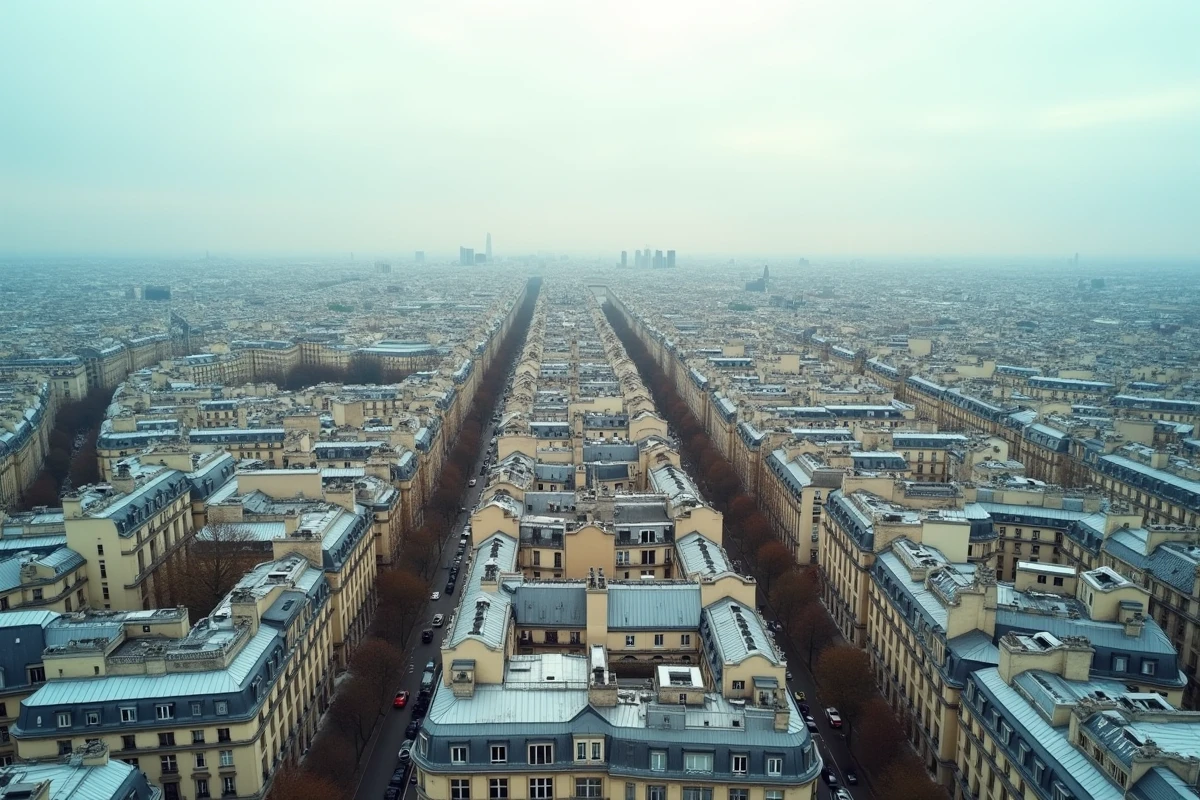
Comparing the area of Paris and London often comes down to opposing two figures: 105 km² versus 1,572 km². London would therefore be fifteen times larger than Paris. This ratio, repeated everywhere, is based on a geographical misunderstanding. The two cities are not divided according to the same administrative logic, and this difference skews any raw comparison.
Why the “fifteen times larger” ratio is misleading
The 105 km² of Paris refers to the intra-muros commune, a perimeter inherited from the 19th century that stops at the périphérique boulevard. The 1,572 km² of London corresponds to Greater London, a regional entity that includes 32 boroughs and the City of London.
In other words, we are comparing a dense city center to an entire metropolis. It’s like measuring an apartment by only counting the living room, then comparing it to a house where you add the garden, garage, and outbuildings.
To better understand this discrepancy, a comparison of the size between Paris and London placed in the context of other major global cities helps to grasp how much the chosen administrative perimeter changes everything.
The City of London, the historical and financial center, covers only 2.9 km². If we were to compare only this London core to intra-muros Paris, the ratio would radically reverse. The administrative perimeter determines the result, not the urban reality.
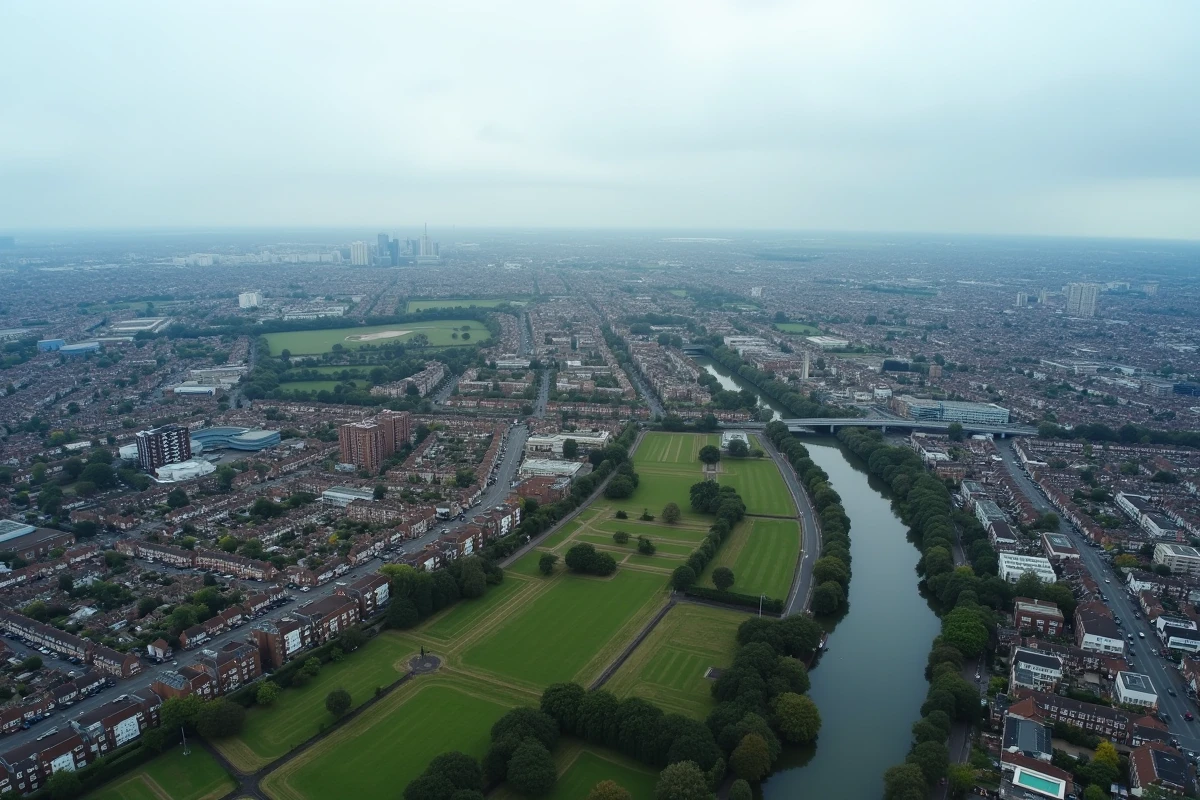
Area of Paris and Greater Paris compared to Greater London
The Métropole du Grand Paris, created in 2016, brings together Paris and dozens of neighboring municipalities. Its perimeter is much larger than the 105 km² intra-muros. If we reason in terms of functional urban area (a zoning used by Eurostat to harmonize European comparisons), the gap between the two capitals is significantly reduced.
Greater Paris, in its broadest sense (urban attraction area according to INSEE), encompasses an extensive suburban ring. With a comparable perimeter, the area difference is greatly reduced.
Three perimeters to understand Paris
- Intra-muros Paris (strict commune): the most restrictive perimeter, which produces the figure of 105 km² and the often-cited record density.
- Métropole du Grand Paris: includes Paris and its nearby municipalities, with a surface area and population significantly higher than the commune alone.
- Urban attraction area of Paris (INSEE zoning): the broadest perimeter, which includes the suburban ring and is closer to what Greater London represents.
Have you noticed that depending on the perimeter chosen, Paris shifts from the status of a compact city to that of a sprawling metropolis? This is exactly the trap of raw comparison.
Population density: the criterion that area alone does not show
Limiting oneself to area masks a fundamental urban reality. Intra-muros Paris has a density of about 21,000 inhabitants per km². Greater London, with its 1,572 km², has an average density of 5,640 inhabitants per km².
Paris is nearly four times denser than London at the current administrative scale. This density explains the verticality of Haussmannian buildings, the narrowness of streets, and the tight mesh of the Paris metro.
In London, density varies greatly from borough to borough. Central neighborhoods like Camden or Islington reach densities close to those of Paris. The peripheral boroughs, on the other hand, resemble more suburban towns with individual houses and gardens.
What density changes in daily life
A dense city concentrates services, shops, and transport in a small space. The Paris metro, with its closely spaced stations, reflects this compactness. The London Tube network covers a much larger territory, but the stations are spaced further apart in the outer areas.
Density shapes the urban experience as much as area does. A Parisian often walks for less time than a Londoner to reach a shop or transport station, despite being in a technically smaller city.

Area and real estate prices: a direct link between the two capitals
The scarcity of land in intra-muros Paris drives prices per square meter to some of the highest levels in Europe. When a city is 105 km² and hosts such a dense population, every square meter becomes a rare commodity.
In London, central real estate (zones 1 and 2) also reaches very high prices. However, the peripheral boroughs offer more accessible prices, precisely because the city has a much larger administrative territory.
- Intra-muros Paris: limited land, maximum density, high prices throughout the commune.
- London zone 1-2: prices comparable to Paris, even higher in some neighborhoods like Kensington and Chelsea.
- London zones 4-6: significantly lower prices, with a more residential setting and abundant green spaces.
This distribution explains why French people moving to London often choose neighborhoods like South Kensington or Hammersmith, which combine proximity to the center with a spacious living environment.
Green spaces and urban organization: two city models
London incorporates vast parks within its administrative perimeter. This ability to absorb green spaces is directly related to its area. Hyde Park, Regent’s Park, Richmond Park: these green lungs occupy a space that intra-muros Paris simply cannot offer in the same proportions.
Paris compensates with smaller but numerous gardens (Tuileries, Luxembourg, Buttes-Chaumont) and proximity to forests on the outskirts. The Parisian model focuses on green density by neighborhood, while the London model emphasizes large parks spread throughout the metropolis.
These two approaches reflect distinct urban planning philosophies. Neither is superior. They respond to different territorial constraints, inherited from centuries of urban development.
The question “which city is larger” therefore does not have a single answer. It depends on the chosen perimeter, the selected criterion (raw area, density, urban area), and what one seeks to measure. Paris and London are two capitals with incomparable territorial logics, and it is precisely this difference that makes each city unique.